|
Collins Commercial HF · Documentation Series The Collins HF-281 TransceiverDocuments, Schematics, Parts, Repair & Restoration — A Resource Guide Mike Peace VK6ADA · r-390a.net and foxtango.org Administrator · vk6ada.com.au |
Rev. 4.1 · October 2026 · Living document — updated as new material surfaces
V4.1 update: adds a small set of source-linked reference photographs while retaining the V4 deep document hunt, including direct confirmation that a 2024 Japanese HF-281 sale included a service-manual PDF; a live 2026 HF-281 auction lead; RigPix contributor provenance; a 1995 manual request; an HF-282 restoration/owner trail; and CU-380 documentation that explicitly cross-references HF-282/HF-282V and the AC-2832 control cable.
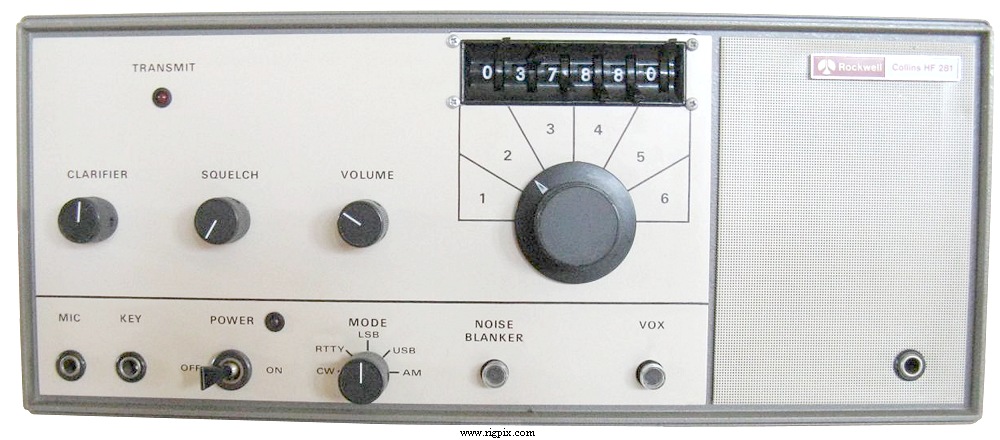
The Rockwell-Collins HF-281 is a late-1970s solid-state HF SSB transceiver built for commercial land-mobile and fixed-station service — and one of the most thinly documented radios ever to carry the Collins name. An S-Line owner can download a complete manual set in minutes. As of this revision, no downloadable complete HF-281 operator/service manual, full schematic set or illustrated parts list has been located on the open web. The search now establishes, however, that at least one English-language HF-281 service-manual PDF survives in private hands: a March 2024 Japanese sale explicitly included a service-manual PDF on CD. Several genuine Rockwell-Collins HF-281/HF-280-family documents and period publications have also been located, including the AC-2808 blower-kit engineering drawing, contemporary HF-280-series advertising, and later CU-380 documentation that directly cross-references HF-282/HF-282V accessories. This guide gathers every verifiable piece of the puzzle: specifications, Collins part numbers, accessories, the closest sister-model documentation, the archives we searched and came up empty, the leads still worth chasing, and sound restoration practice for a radio you may have to service without a book.
|
How to Read This Guide Verified means a cited source states it. Inference means it is our reasoning from the evidence, and it is labelled as such every time. Unconfirmed lead means a search turned it up but we could not read or check the content. With so little primary documentation in circulation, keeping these three apart is the whole point of the exercise. |
1. Identification & Background
RigPix catalogues the HF-281 as a professional land-mobile HF transceiver, built in the USA from 1978 to 1982.[1] That places it squarely in the Rockwell-Collins era, following Rockwell’s 1973 takeover of the Collins Radio Company,[2] when the Cedar Rapids product line was moving decisively to solid-state, synthesised designs.
The feature set is a hybrid of two worlds. Six fixed operating channels are programmed through a diode matrix — the classic arrangement for a commercial network radio that must come up on the right frequency every time — while synthesised tuning in steps from 100 Hz up to 10 MHz gives the operator general-coverage flexibility.[1] It runs from 110 or 230 V AC or from 12 V DC, so a single model could serve a homestead base station, a vehicle installation, or a site running on battery and solar.[1]
1.1 Reading the Data Plate
Collins commercial equipment of this period is identified by a 622-series part number with a dash suffix; in the contemporary HF-80 family, Collins used the three-digit extension to identify a unit’s configuration.[3] The HF-380 transceiver, for example, is 622-3580-001,[4] and the CU-281 automatic antenna coupler built for the HF-281 is 622-3533-001.[5] Record the full part number, dash suffix, serial number and any modification-status markings from your HF-281 before anything else — they are the keys that will match your radio to a manual if one ever surfaces, and they help map how many configurations existed.
2. Known Specifications
Everything below is stated by a cited source. Blank fields on the RigPix page — IF scheme, sensitivity, selectivity, microphone interface, antenna connector — are listed separately as unknowns rather than guessed.
| Parameter | HF-281 | Source |
|---|---|---|
| Type | Professional land-mobile HF transceiver | [1] |
| Production | USA, 1978–1982 | [1] |
| Frequency coverage | 1.6–30 MHz. RigPix’s model page says 1.6–20 MHz, but its own index says 1.6–30 MHz; contemporary 1979 and 1980 published descriptions of the HF-280 Series independently state 1.6–30 MHz, making 1.6–20 MHz very likely a RigPix model-page error.[23][24] | [1] [6] |
| Tuning | Synthesised; 100 Hz, 1/10/100 kHz and 1/10 MHz steps | [1] |
| Channels | Six fixed frequencies, diode-matrix programmed | [1] |
| Modes | Transmit SSB / CW; receive AM / SSB / CW / RTTY | [1] |
| RF output | 125 W into 50 Ω | [1] |
| Power input | 110 or 230 V AC, or 12 V DC | [1] |
| Transmit current | 10 A at 110 V AC; 4 A at 230 V AC | [1] |
| Dimensions (W×H×D) | 394 × 190 × 457 mm (15.5 × 7.48 × 18 in) | [1] |
| Weight | 24.2 kg (53.35 lb) | [1] |
| USB selectivity | Plug-in Collins mechanical filter 526-9897-010: 455 kHz, 2.1 kHz at −3 dB, 6.25 kHz at −60 dB, 2.7 kΩ in/out | [7] [8] |
| Antenna coupler | CU-281 automatic coupler, 622-3533-001 | [5] |
Still unknown or not independently verified: receiver sensitivity, synthesiser and reference-oscillator details, front-panel display/control circuitry, microphone and accessory connector pinouts, the transceiver’s own 622-series part number, and the Collins manual (523-series) document number. A March 2024 Japanese surplus listing states that the HF-281 uses a 39.145 MHz first IF with an 8 kHz monolithic filter, a 455 kHz second IF, and a push-pull pair of MRF421 PA transistors. Those details are independently consistent with the KWM-380 architecture, but they remain seller-stated and unverified until checked against the HF-281 service manual or a radio on the bench.[29] Section 11 explains how to contribute primary documentation.
3. The KWM-380 / HF-380 Connection
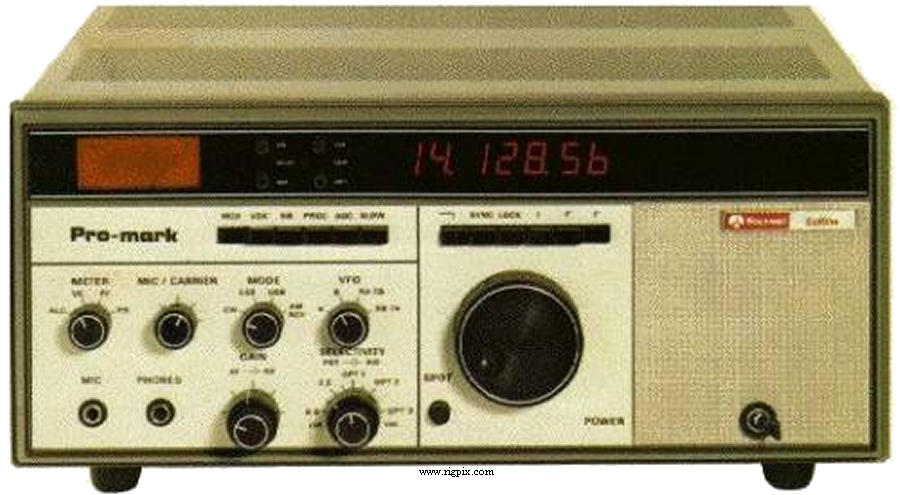
The HF-281 shares its era with Collins’ last amateur transceiver, the KWM-380, and its commercial counterpart, the HF-380 — RigPix describes the HF-380 as the commercial version of the KWM-380.[9] Lined up side by side, the published figures are hard to ignore:

| Attribute | HF-281 | KWM-380 | HF-380 |
|---|---|---|---|
| Introduced | 1978 (built to 1982)[1] | 1979[10] | 1979[9] |
| Width × depth | 394 × 457 mm[1] | 394 × 457 mm[11] | See owner’s manual[4] |
| Height | 190 mm[1] | 165 mm + 25 mm feet = 190 mm[11] | — |
| Weight | 24.2 kg[1] | 21.8 kg max[11] | — |
| Power options | 110/230 V AC or 12 V DC[1] | 105–250 V AC strappable, or 12–15 V DC[11] | Mains powered[9] |
| RF output | 125 W[1] | 100 W[10] | 100 W[9] |
| Transmit coverage | 1.6–20 or 1.6–30 MHz[1][6] | 160–10 m amateur bands + WARC[10] | 1.6–30 MHz[9] |
| Collins part number | Unknown; its CU-281 coupler is 622-3533-001[5] | — | 622-3580-001[4] |
|
Confirmed Mechanical / Accessory Family Link — Circuit Equivalence Still Unproven The link is stronger than dimensional similarity. Rockwell-Collins engineering drawing 622-3547 for the AC-2808 blower kit explicitly lists HF-281, HF-282, HF-380 and KWM-380 in its applicability / next-assembly information. Sheet 2 contains separate HF-281 and HF-282 modification instructions and identifies the A1A1 interface card and the HF-281/282 low-pass-filter switch. This confirms that the HF-281 belongs to the same mechanical/accessory design program and shares at least some installation architecture with the KWM/HF-380 family.[22] Surplus Sales of Nebraska likewise files the CU-281 among KWM/HF-380 accessories.[12] The blower-kit drawing does not prove that the receiver, synthesiser, IF, PA or control circuits are electrically identical. Until an HF-281 service manual turns up, treat KWM-380 and HF-380 documents as useful references for shared hardware and design practice — not as a substitute for HF-281 schematics. Never set alignment points on an HF-281 from KWM-380 data without first proving the circuit matches. |
4. HF-281 Documentation Library — Status
This is the honest state of the HF-281 paper trail as of October 2026. Each row will be updated as material is located.
| Document | Status | Notes & Source |
|---|---|---|
| Owner’s / operator’s manual | Not located | No entry on BAMA, the CCA manuals index, RigPix or opweb.de[13][14][1] |
| Service / maintenance manual & schematics | Not located | No public scan has been located. The March 2024 Aleado/Yahoo! Japan mirror now directly confirms that seller gakkoh33 included a service manual (PDF) on CD with an HF-281. The same listing gives detailed receiver/PA architecture, but does not itself expose the manual pages. A second mirror previously indexed with wording indicating circuit diagrams and a parts list was unavailable on this re-check, so that extra description remains secondary. The manual therefore demonstrably survives in private hands, but has not yet been obtained for independent inspection.[29] Nearest public stand-in: the HF-380 service manual in the CCA archive (Section 6) |
| Parts list / illustrated parts breakdown | Not located | A complete illustrated parts list remains missing, but additional public part numbers have now been verified: CU-281 622-3533-001; AC-2808 blower kit 622-3547-001; USB filter 526-9897-010; AM filter 526-9920-010; and LSB filter 526-9939-010 (Sections 5 and 6) |
| Service bulletins / SILs | Not located | None in the CCA bulletin archive or BAMA’s Collins folders[14][13] |
| Product sheet / brochure / period advertising | Period material located | Period Rockwell-Collins HF-280-Series advertising and contemporary trade/amateur press descriptions have been located. A dedicated multi-page HF-281 brochure is still wanted.[23][24][25] |
| Collins manual number (523-series) | Unknown | For comparison, the KWM-380 owner’s manual is 523-0769877-002217 and the HF-380 owner’s manual 523-0769879-002217.[11][4] If the HF-281 books came from the same publications group, a nearby number is plausible (inference) |
| Specifications & photograph | Located | RigPix model page, partial[1] |
| CU-281 coupler documentation | Not located | Surplus Sales notes its unit is supplied without documentation[5] |
| Period advertising | Located | Contemporary Rockwell-Collins HF-280-Series advertising is preserved in period publications, including a March 1980 QST advertisement; another international ad explicitly names the HF-281 with CU-281 and HF-282 with CU-282.[24][27] |
4.1 Newly Located HF-281 / HF-280-Series Documents
- Rockwell-Collins AC-2808 Blower Kit Assembly, drawing 622-3547 — the most important newly located technical document. The title block explicitly includes HF-281, HF-282, HF-380 and KWM-380, and sheet 2 gives HF-281/HF-282-specific modification instructions.[22]
- 73 Magazine, March 1979 — contemporary report identifying HF-281 as six-channel and HF-282 as twenty-channel, both 125 W and tunable 1.6–30 MHz in 100-Hz increments.[23]
- QST, March 1980 — period Collins HF-280-Series advertising: 125 W, 110/220 V AC or 12 V DC, six or twenty channels, 1.6–30 MHz.[24]
- CCA Signal, Issue 72, Q4 2013 — Dave Berner’s history of the HF-280 / KWM-380 development program, including an HF-282 photograph and confirmation that the HF-280 series was introduced in spring 1978.[25]
- Collins Mechanical Filter Cross-Reference — identifies HF-281/HF-282 USB 526-9897-010, AM 526-9920-010 and LSB 526-9939-010.[26]
- 73 Magazine, March 1995 — Ham Help — contains a period request reading, “NEEDED: Any manuals or programming information for ROCKWELL-COLLINS HF-281.” This does not locate the manual, but documents that owners were already searching for it by 1995.[32]
- RigPix provenance entry, 4 December 2010 — the site records “Rockwell-Collins HF-281 (TNX to SA7ATK)”, identifying a specific contributor who supplied the HF-281 entry and may have had access to the radio or source material.[31]
- CU-380 Antenna Coupler Instructions, August 1982 — Table 2 explicitly lists HF-282, HF-282V, HF-380 and KWM-380 and identifies the AC-2832 transceiver-to-coupler control cable. The installation text says HF-282/HF-282V use the AC-2832 directly, whereas HF-380/KWM-380 use an AC-3809 interface adapter. This is direct evidence that later “380” manuals can contain hidden HF-280-family documentation.[36]
5. Parts & Accessories
| Item | Collins P/N | Details |
|---|---|---|
| CU-281 Automatic Antenna Coupler | 622-3533-001 | All-band automatic tuner described by Surplus Sales as “made specifically for HF-281”. UHF-series unbalanced input; high-voltage insulated standoff for single-wire feed to a vertical or long wire. Offered without documentation[5] |
| AC-2821 DC standby power cable | 622-3564-001 | Two-metre DC power cable listed in the KWM-380 owner’s-manual accessories; period Lowe Electronics price lists place it in the same HF-280/KWM-380 accessory family as the MM-280 handheld microphone, MM-281 noise-cancelling microphone and SM-280 desk microphone. A six-pin power connector/socket described for HF-281/HF-282/451S-1 also survives in the parts market.[28] |
| USB mechanical filter (plug-in) | 526-9897-010 | 455 kHz centre; 2.1 kHz at −3 dB, 6.25 kHz at −60 dB; 2.7 kΩ in/out; 0.7 × 1 × 2.78 in.[7] The HF-282 is independently documented in period press and Collins historical material; the filter cross-reference also lists this filter for both HF-281 and HF-282.[8][23][26] |
| AM mechanical filter | 526-9920-010 | Collins mechanical-filter cross-reference lists HF-281 & HF-282, AM, nominal 5-kHz entry.[26] |
| LSB mechanical filter | 526-9939-010 | Collins mechanical-filter cross-reference lists HF-281 & HF-282, LSB, nominal 1.95-kHz entry.[26] |
| PA transistors | Unknown | The KWM-380 uses a push-pull pair of Motorola MRF421s.[17] A 2024 Japanese HF-281 surplus listing independently states MRF421 × 2, but this remains seller-stated rather than manual-verified.[29] Read the device markings on your own PA before treating it as confirmed |
| Synthesiser, reference oscillator, display, control boards | Unknown | Photograph and record board numbers; these are the most likely modules to be shared with the KWM-380/HF-380 if the family inference holds |
Where to look for spares: Surplus Sales of Nebraska carries Collins mechanical filters across two catalogue pages[7] and a KWM/HF-380 accessories page that includes the CU-281, KWM-380 and HF-380 service manuals, and KWM/HF-380 filters.[12] Beyond that, the usual Collins parts specialists, the CCA and Collins groups.io reflectors, and hamfest tables are the realistic sources.
6. Sister-Model Reference Documents
If the family inference in Section 3 holds, these are the best documents available to an HF-281 owner today. They are excellent, free, and well worth having on the bench — read them for construction practice and fault-finding approach, and cross-check every circuit detail against your own radio.
| Document | Collins No. | Where |
|---|---|---|
| HF-380 Service Manual | — | CCA archive, free[14] |
| HF-380 User’s Manual | — | CCA archive, free[14] |
| HF-380 Owner’s Manual, 2nd ed., 1 April 1981 | 523-0769879-002217 | ManualsLib, free to view[4] |
| KWM-380 Owner’s Manual, 2nd ed., 1 January 1981 | 523-0769877-002217 | CCA archive, free[11] |
| KWM-380 Service Manual and 1982 Service Bulletins | — | BAMA, free[13] |
| KWM-380 Self-Study course | — | CCA archive, free[14] |
| KWM-380 Service Bulletins 1–18 and Service Information Letters | — | CCA manuals index, free[14] |
| KWM-380 power supply schematics, parts layout and parts lists | — | CCA manuals index, free[14] |
| KWM-380 and HF-380 blower kit assembly and drawing | — | CCA manuals index, free[14] |
| CU-380 Antenna Coupler Instructions, 1 August 1982 — especially important because its equipment table explicitly lists HF-282/HF-282V alongside HF-380/KWM-380 and identifies AC-2832 control cabling. It does not list HF-281 in the checked pages, so it is evidence of family documentation practice rather than a CU-281 substitute. | CU-380 P/N 622-3573-001 | CCA archive, free[36] |
| “CQ Reviews: The Rockwell-Collins KWM-380 Transceiver” by John J. Schultz W4FA, CQ, November 1982 — architecture overview: 39.145 MHz first IF, 455 kHz second IF | — | CCA reprint, free[18] |
| KWM-380 catalogue specifications (Japanese) — PA device and IF data | — | collins-21.com, free[17] |
| Printed HF-380 service manual, KWM-380 service and training manuals | — | Surplus Sales of Nebraska, paid[12] |
7. Archive Search — What Was and Was Not Found
Negative results are worth publishing — they save the next restorer an afternoon. The archive search below has now produced useful HF-280/HF-281/HF-282 material, but still no complete HF-281 operator/service manual or full schematic set:
| Archive | What was checked |
|---|---|
| BAMA — Collins | Collins directory, service-bulletin and Signal folders[13] |
| Collins Collectors Association | Equipment manuals index and service-bulletin archive[14] |
| Collins Aerospace Museum | Products database (early products are still being catalogued) and brochure index[15] |
| Radiomuseum.org | Collins Radio Company model lists[2] |
| hf-80.com (Jim Stitzinger Jr. WA3CEX) | HF-80 family history, elements and catalogue pages — no evidence the HF-281 belongs to the HF-80 family[3] |
| opweb.de, RigReference, mods.dk, ManualsLib | Model and document listings for Rockwell-Collins |
| groups.io CollinsRadios / collector discussions | An August 2025 HF-281 owner request for manuals/documentation did not surface a public copy. This is useful negative evidence, but private holdings may of course exist. |
| FCC equipment authorisation database | Re-checked October 2026, including Rockwell Collins grantee code AJK: no HF-281 filing located. The search result PN822-2764 is a later 2011 2–30 MHz HF transceiver and is unrelated to the 1978 HF-281.[30] |
| WorldRadioHistory.com | Useful material found: March 1979 73 Magazine describes the HF-281/HF-282 and 1.6–30 MHz coverage; March 1980 QST carries an HF-280-Series Collins advertisement. No complete HF-281 manual located.[23][24] |
7.1 V4 Deep-Search Pass — Additional Sources
To avoid repeatedly searching the same well-known manual sites, V4 deliberately expanded into additional repositories and provenance sources. The entries below record the result of this pass; “no manual surfaced” means the targeted indexed search did not return a usable HF-281 manual, not that the repository can be proven to contain none.
| New source / route | Result of V4 pass |
|---|---|
| Survivor Library | Useful lead: located the March 1995 73 Magazine Ham Help request for HF-281 manuals/programming information.[32] |
| Takayama Musen technical department | Actionable provenance lead: technician profile shows a modified HF-282 in the shack and says the shop maintains manufacturers’ service manuals and specialized tools. No HF-281 PDF is posted, but this is a strong contact route.[33] |
| Schulman Auction / HiBid | Live provenance lead: HF-281 serial 690 offered in the 17 Sep–1 Oct 2026 sale; the same estate includes HF-380, KWM-380, CU-380 and 851S-1. No manual is listed with lot 23, making the auction house/consignor worth asking about uncatalogued binders, CDs and papers.[35] |
| RigPix change-history / contributor provenance | Useful lead: identifies SA7ATK as the contributor behind the HF-281 entry in December 2010.[31] |
| CCA Signal Issue 50 collector profile | Restoration provenance lead: documents Cliff Crane W4NJ’s rare HF-282 equipment and states Bob Hardie W5UQ was restoring Cliff’s HF-282s.[34] |
| EA1URO / EB1DGC manual index | Useful mirror: independently indexes the CU-380 service PDF, but no HF-281 manual surfaced in the targeted pass. |
| Google Groups / Usenet archive | Parts evidence: a 2001 discussion reproduces HF-281/HF-282 filter cross-reference entries; no full manual surfaced.[26] |
| WorldCat | Targeted HF-281 / Rockwell-Collins manual search: no usable manual catalog record surfaced in this pass. |
| Google Books | Targeted model/manual search: no relevant HF-281 service publication surfaced. |
| HathiTrust | Targeted search did not surface an indexed HF-281 manual. |
| Defense Technical Information Center (DTIC) | No HF-281 technical manual or report surfaced in the targeted indexed search. |
| Bitsavers | No indexed HF-281 or matching Collins service-manual scan surfaced in this pass. |
| Elektrotanya | No HF-281 service manual surfaced in the targeted search. |
| ManualMachine | No relevant HF-281 manual surfaced in the targeted indexed search. |
8. Leads Worth Following
- Japanese Yahoo! Auctions seller gakkoh33 — highest-priority manual lead. The March 2024 Aleado mirror directly shows seller gakkoh33 (Osaka region) offering an HF-281 and explicitly listing a service manual (PDF) on CD among the accessories. The detailed description also gives IF, PA and filter information. The auction is closed, but the seller identity is now concrete and should be pursued through the Yahoo/Aleado seller-contact route. Aleado auction q1128097128.[29]
- Schulman Auction & Realty / current Collins estate — time-sensitive lead. Lot 23 in the 17 September–1 October 2026 sale is an HF-281, serial 690. The same sale contains an HF-380, KWM-380, CU-380 and 851S-1 plus other Collins material. Although lot 23 does not list a manual, this concentration makes the auction house/consignor an unusually strong lead for loose binders, CDs, photocopies or papers that may have been separated from the radio. HF-281 lot 23.[35]
- Takayama Musen technical department, Japan. Its technician profile shows a modified Rockwell-Collins HF-282 in the shack and states that manufacturers’ service manuals and specialized service tools are kept on hand. This does not prove possession of an HF-281/HF-282 manual, but it is a technically credible Japanese contact with direct HF-282 experience. Takayama Musen technician profile.[33]
- RigPix contributor SA7ATK. RigPix’s own change log credits SA7ATK for the HF-281 entry on 4 December 2010. Because RigPix’s HF-281 data had to come from somewhere, contacting the contributor is a direct provenance path to photographs, notes or documents used to build that entry.[31]
- HF-282 collector/restorer trail: W4NJ and W5UQ. CCA Signal Issue 50 documents Cliff Crane W4NJ owning rare HF-282 equipment and states that Bob Hardie W5UQ was restoring Cliff’s HF-282s. A person who performed a serious restoration is a plausible source for copied schematics, alignment data or service notes.[34]
- 1995 73 Magazine Ham Help requester. The March 1995 issue contains a request for “Any manuals or programming information for ROCKWELL-COLLINS HF-281.” If the named requester or respondents can be traced through callsign/address archives, this becomes an older owner-to-owner provenance path.[32]
- Collins mailing-list archive. A September 2009 message titled “More manuals & instruction sheets for sale” matched an HF-281 search, but the archive blocked automated reading and the content is unconfirmed. It is the most promising pointer yet toward a physical HF-281 book.[19]
- The CCA reflector. Post your data-plate number and board photos to the Collins Collectors Association group on groups.io; members with commercial-division or field-service backgrounds are the people most likely to hold HF-281 paperwork.[20]
- Collins filter cross-reference tables. The mechanical filter reference material collected at wa3key.com may identify companion filters (LSB, CW, AM) in the 526-98xx range used alongside the 526-9897-010.[21]
- Trade-press full-text search. Search WorldRadioHistory.com for “HF-281” across 1978–1983 commercial communications and land-mobile trade titles, not just amateur magazines.
- Former network users and technicians. Land-mobile HF networks of the period — resources, pastoral, utilities, emergency and outback services — ran Collins commercial gear. Retired network technicians are an under-used source of manuals that never made it online.
- Collins Aerospace legacy publications. A polite enquiry quoting your radio’s full 622-series part number costs nothing; obsolete commercial manuals occasionally surface this way.
|
Unconfirmed Technical Details from the Japanese Listings The Aleado/Yahoo auction text states that the HF-281 uses many common parts / the same basic-board concept as the HF-380/KWM-380 and gives a 39.145 MHz first IF (with an 8-kHz monolithic filter), 455 kHz second IF, MRF421 × 2 PA, 125 W output, and a bank of low-pass filters. A correction appended by the seller says five LPF sections are fitted, with the 24/28-MHz position effectively through/bypass rather than a sixth filter. These details align closely with known KWM-380 architecture, but they remain seller statements until the referenced HF-281 service-manual PDF or a physical radio confirms them.[29] |
9. Restoration & Repair Guidance
With no public HF-281 service manual currently in circulation, what follows is sound practice for solid-state Collins commercial HF equipment of the 1978–82 period, adapted to what is actually known about this radio. Where a step depends on information we do not have, it says so.
|
⚠ Safety First The HF-281 contains a mains power supply strappable for 110 or 230 V and draws up to 10 A on transmit from a 110 V line.[1] Treat the supply section with full mains respect and discharge filter capacitors through a bleeder before working on it. On the 12 V DC side, a battery or large bench supply can deliver hundreds of amps into a fault — always fuse the DC lead close to the source. At 125 W, the output and especially the CU-281’s single-wire standoff carry RF voltages that burn: never touch the antenna system while transmitting. |
9.1 Triage & Documentation
Before a screw is turned, build the record that does not exist anywhere else. Photograph every face of the radio and every board, top and bottom, in situ. Record the data plate (part number, dash suffix, serial, any modification-status marks), every board number and revision letter, every plug-in filter part number and position, and the PA device markings. Note what came with the radio: microphone, mounting cradle, DC cable, coupler, control cables. Your photographs may become the first public board-level reference for this model.
9.2 Voltage Strapping & Controlled First Power-Up
- Confirm the AC strapping before anything else. Commercial HF radios travelled the world, and a unit strapped for 110 V connected to 230 V can destroy its own supply in seconds. Find the strapping arrangement, confirm it matches your mains, and fit the correct fuse value.
- Prefer a current-limited DC bring-up if you can. If the 12 V DC input is accessible, a bench supply with an adjustable current limit is the gentlest first light a solid-state radio can get. Confirm input polarity on the connector before connecting — do not assume. Start receive-only with a low current limit and watch the meter: a supply that slams into its limit means a shorted rail, not a radio that needs more amps.
- On AC, use a dim-bulb tester or variac. Bring the line up gradually while watching current draw, and stop at the first sign of anything rising that should be settling.
- Survey the regulated rails. Without a voltage chart, measure and log every regulator output you can identify. A rail that sits well off a standard value (5, 12, 15, 24 V and so on) is worth investigating before going further.
9.3 Capacitors
Every aluminium electrolytic in an HF-281 is now well over forty years old. The main filter capacitors in the AC supply and the DC input filtering are first-order risk items: reform them slowly on a current-limited supply if you want to preserve originals, or replace them with modern 105 °C parts of equal or higher voltage and the same capacitance. If the boards use solid tantalum bead capacitors — common in commercial gear of this era — be aware that their usual failure mode is a dead short, often on a supply rail, frequently accompanied by a hot or scorched body. A rail that pulls the bench supply into current limit is the classic symptom.
9.4 Connectors, Relays & Controls
Modular commercial radios live and die by their inter-board connectors. Unplug, inspect, clean with DeoxIT D5 and reseat every board-to-board and edge connector, one at a time so nothing goes back in the wrong place. Exercise the channel selector and front-panel controls through their full travel after a careful contact treatment. Listen to the transmit/receive relay operate; sluggish or chattering relays are a common source of low output and intermittent receive.
9.5 The Diode Matrix
The six fixed channels are set by a diode matrix.[1] Photograph it and record the frequency each channel produces before any work — those frequencies are also part of the radio’s provenance, telling you which network it served. A cracked diode, a cold joint or a lifted pad typically shows up as one channel landing on the wrong frequency or not at all, while synthesised tuning and the other channels work normally. Map the pattern carefully against measured frequencies before attempting to reprogram anything.
|
⛔ Licensing Caution The channels programmed into an ex-commercial HF-281 are almost certainly outside the amateur bands. Do not transmit on them without the appropriate authorisation. For amateur use, transmit only within the bands and power limits of your own licence, and remember the radio was built for commercial service — confirm its emission quality on a spectrum analyser or receiver before it goes on air. |
9.6 Frequency Reference
A synthesised radio is only as accurate as its reference oscillator. Check displayed or dialled frequency against a known standard — WWV, WWVH or BPM, or a GPS-disciplined counter — across several frequencies. If correction is needed, locate the reference trimmer, mark its original position, and make the smallest adjustment that brings it into agreement. Without a service manual, resist touching any other synthesiser adjustment.
9.7 Transmitter & PA
First transmission goes into a dummy load through a wattmeter, at reduced drive, for short periods. Watch supply current, heat-sink temperature and output together. Identify the PA devices from their markings before you need spares: the KWM-380 uses push-pull MRF421s,[17] but your HF-281 may not. Classic RF power transistors are a heavily counterfeited category — buy only from reputable RF specialists and be suspicious of cheap matched pairs. While the PA is accessible, renew the thermal compound and confirm any cooling fan runs freely.
9.8 Filters
The 526-9897-010 USB filter is a plug-in unit.[7] Remove it, clean the pins and socket, and reseat it. Spares are currently inexpensive and available,[7][8] so if your receiver sounds deaf or mushy on SSB while AM is healthy, swapping the filter is a cheap and quick test.
9.9 The CU-281 Coupler
If your radio arrived with its coupler, test the transceiver first into a dummy load with the coupler disconnected, then bring the coupler in as a separate stage. The CU-281 feeds a single-wire antenna from an insulated high-voltage standoff,[5] so route that wire well clear of people and structures. Control-cable pinout and tuning logic are undocumented; record both if you can trace them. The CU-380 service document in the CCA archive may be a useful conceptual reference, but treat it as inference until a CU-281 manual appears.[14]
9.10 Alignment
The rule for a radio without a book is simple: measure, record, and only then adjust — and only what measurement proves needs it. A working HF-281 that is a little deaf on one band is far easier to live with than one whose IF and synthesiser have been tweaked into a state nobody can document. Log sensitivity, output and frequency accuracy on several bands as your baseline before any adjustment, and share those figures — they would be the first published performance data for this radio.
10. First-Checks Quick Reference
General first suspects for a solid-state commercial HF transceiver of this period. Not HF-281-specific service data.
| Symptom | First Suspects |
|---|---|
| Completely dead on AC | Fuse, line-voltage strapping, power switch, AC supply rectifiers and filter capacitors |
| Dead on 12 V DC only | DC cable and fuse, input polarity protection, DC input connector |
| Bench supply hits current limit at switch-on | Shorted tantalum or electrolytic on a supply rail; shorted regulator or PA device |
| One fixed channel wrong or dead, others fine | Diode-matrix diode or joint for that channel; channel-selector switch contact |
| No signals on any frequency | Synthesiser lock or reference oscillator, a missing supply rail, a poorly seated board connector |
| Weak or mushy SSB, AM normal | USB filter seating or failure (swap the 526-9897-010), BFO / carrier injection |
| Low or no transmit output | T/R relay, ALC, PA supply, coupler fault — retest into a dummy load with the coupler bypassed |
| Intermittents when the chassis is tapped | Edge and inter-board connectors, cold solder joints, cracked board traces near heavy components |
11. Help Build the HF-281 Archive
|
Do You Have HF-281 Material? If you own an HF-281, HF-282, CU-281 or anything bearing those numbers — a manual, a schematic sheet, a parts list, a brochure, a data-plate photo, or simply clear photographs of the boards — please get in touch through vk6ada.com.au. Scans and photographs will be credited by name and callsign, and this guide will be updated so the next owner does not start from zero. Highest priority: obtain and preserve the English-language HF-281 service-manual PDF that seller gakkoh33 included with the March 2024 Japanese HF-281 sale. Parallel contact priorities are the current Schulman Auction/consignor for HF-281 serial 690, RigPix contributor SA7ATK, Takayama Musen in Japan, and the W4NJ/W5UQ HF-282 collector/restorer trail. Also wanted: the HF-281 transceiver’s own 622-series part number; its Collins 523-series manual number; primary confirmation of the 39.145 MHz / 455 kHz IF scheme and MRF421 × 2 PA; microphone/accessory connector pinouts; HF-281-specific service bulletins; and CU-281 documentation. The 1.6–30 MHz coverage and mechanical/accessory family link are now supported by period sources. |
Footnotes
Links checked October 2026 where possible. Notes 19 and 21 were retained from earlier search results. Note 29 now uses the directly readable Aleado/Yahoo mirror; the service-manual PDF is explicitly listed there, while the manual itself has not been inspected. Marketplace and auction listings may expire.
- RigPix Database, Rockwell Collins HF-281 — type, 1978–1982 production, 1.6–20 MHz coverage, tuning steps, six diode-matrix channels, modes, 125 W output, AC/DC power and current, dimensions and weight. ↩
- Radiomuseum.org, Collins Radio Company, Cedar Rapids (IA) — company history including the 1973 Rockwell takeover. ↩
- Jim Stitzinger Jr. WA3CEX, HF-80 Elements, hf-80.com — HF-80 series part numbering, with the three-digit extension identifying unit configuration. ↩
- Rockwell International Collins, HF-380 Owner’s Manual, 2nd edition, 1 April 1981, document 523-0769879-002217; transceiver part number 622-3580-001. Hosted by ManualsLib. ↩
- Surplus Sales of Nebraska, CU-281 Automatic Antenna Coupler, Collins 622-3533-001 — built for the HF-281; UHF unbalanced input, HV insulated single-wire output standoff; no documentation supplied. ↩
- RigPix Database, Professional Transceivers index — lists the HF-281 as 1.6–30 MHz, 125 W, 1978, conflicting with the model page. ↩
- Surplus Sales of Nebraska, Mechanical Filter 526-9897-010 — 455 kHz USB plug-in filter, 2.1 kHz / 6.25 kHz bandwidths, 2.7 kΩ impedance, dimensions. See also the Collins Filters & Crystals catalogue pages. ↩
- eBay listing by seller BizBonanza, Collins 526-9897-010 Mechanical Filter — HF-281 HF-282 USB Plug-in — the only located source naming the HF-282. ↩
- RigPix Database, Rockwell Collins HF-380 — 1979, 1.6–30 MHz transmit, 100 W, mains powered; described as the commercial version of the KWM-380. ↩
- RigPix Database, Collins/Rockwell index — KWM-380: 1979, 100 W, 160–10 m plus WARC, Collins’ last amateur transceiver. ↩
- Rockwell-Collins, KWM-380 Owner’s Manual, 2nd edition, 1 January 1981, document 523-0769877-002217 — dimensions (394 × 165 × 457 mm plus 25 mm feet), 21.8 kg, AC strapping and 12–15 V DC operation. Collins Collectors Association archive. ↩
- Surplus Sales of Nebraska, Collins: KWM / HF-380 Accessories — lists the CU-281 alongside KWM-380/HF-380 accessories, printed manuals and filters. ↩
- BAMA — Boat Anchor Manual Archive, Collins manuals and KWM-380 folder (service manual; 1982 service bulletins). No HF-28x entries. ↩
- Collins Collectors Association, Collins Radio Equipment Manuals — HF-380 service and user manuals (contributed “de Katz”), KWM-380 manuals, self-study course, service bulletins 1–18, SILs, power-supply documents, blower kit drawings and the CU-380 service document. The index does not expose a standalone HF-281 manual, but its AC-2808 blower-kit drawing is directly applicable to HF-281/HF-282 as well as HF-380/KWM-380. ↩
- Friends of the Collins Aerospace Museum, Products database — early-products catalogue, still in progress; no HF-28x entries. ↩
- eBay listing, 1980–81 Rockwell Collins HF Communication advertisement (718U, HF-280, AN/ARC-190) — paper ephemera; ad text not reproduced in the listing.
- Over The Top KWM-380 HF-380, KWM-380 catalogue specifications (Japanese), collins-21.com — Motorola MRF421 push-pull PA; 39.145 MHz and 455 kHz IFs. ↩
- John J. Schultz W4FA, “CQ Reviews: The Rockwell-Collins KWM-380 Transceiver,” CQ, November 1982; reprinted by the Collins Collectors Association on its KWM-380 page. ↩
- Collins mailing list archive, “More manuals & instruction sheets for sale,” September 2009 — search match only; content unconfirmed. ↩
- Collins Collectors Association, [email protected] reflector. ↩
- WA3KEY, Rockwell/Collins Mechanical Filters — filter theory, operating parameters and catalogue reference material. ↩
- Rockwell International / Collins Groups, AC-2808 Blower Kit Assembly drawing 622-3547. The drawing’s applicability / next-assembly line includes HF-281, HF-282, HF-380 and KWM-380; sheet 2 contains HF-281/HF-282-specific installation and high-power modification instructions. Collins Collectors Association scan. ↩
- 73 Magazine, March 1979, period report on Collins commercial solid-state transceivers — HF-281 six preset channels; HF-282 twenty channels with plug-in PROM capability; 125 W and 1.6–30.0 MHz in 100-Hz increments. World Radio History scan.
- QST, March 1980, Rockwell-Collins HF-280 Series advertisement — 125 W, 110/220 V AC or 12 V DC, six or twenty programmable channels, 1.6–30 MHz. World Radio History scan.
- Dave Berner, “Concept to Market, HF-80 & Casper,” Collins Collectors Association Signal, Issue 72, Q4 2013, PDF — history of the HF-280-series and KWM/HF-380 development program.
- Collins Mechanical Filters cross-reference, mykit.com mirror — HF-281/HF-282 USB 526-9897-010, AM 526-9920-010, LSB 526-9939-010. A 2001 Usenet discussion independently repeats the USB and LSB HF-281/HF-282 entries.
- Rockwell-Collins international HF-280-Series advertisement, preserved in a scanned period publication at the National Library of Nigeria repository, PDF scan — explicitly identifies HF-281 with CU-281 and HF-282 with CU-282, and describes the series as AC/DC, fixed or mobile, solid state HF equipment.
- Rockwell-Collins KWM-380 owner’s-manual accessory information lists the AC-2821 DC Standby Power Cable as Collins P/N 622-3564-001. Contemporary Lowe Electronics advertisements/price lists in Short Wave Magazine (September and November 1980) place the AC-2821 alongside the MM-280 handheld microphone, MM-281 noise-cancelling microphone and SM-280 desk microphone in the same Collins accessory family. Contemporary/secondary parts-market listings also identify a six-pin power connector/socket for HF-281/HF-282/451S-1.
- March 2024 Yahoo! Auctions Japan / Aleado mirror, auction q1128097128, seller gakkoh33, Osaka region. The readable listing explicitly includes a service manual (PDF) on CD among the accessories and states 1.6–30 MHz coverage, 39.145 MHz first IF, 455 kHz second IF, MRF421 × 2 PA and 125 W output. It also describes commonality with HF-380/KWM-380. A seller correction clarifies the LPF arrangement. These technical details are seller-stated; the referenced manual has not yet been independently inspected. A second mirror used in V3 was unavailable during the V4 re-check. ↩
- Targeted October 2026 re-check of the FCC equipment-authorization database, including Rockwell Collins grantee code AJK. No HF-281 filing was identified; PN822-2764 is a separate 2011-era 2–30 MHz HF transceiver and should not be conflated with the HF-281.
- RigPix Database, What’s New 2010, entry dated 4 December 2010: “Rockwell-Collins HF-281 (TNX to SA7ATK).” This identifies the contributor behind the HF-281 database addition and creates a provenance/contact lead. ↩
- 73 Magazine, March 1995, Ham Help column, preserved by Survivor Library and other magazine archives. It contains the request: “NEEDED: Any manuals or programming information for ROCKWELL-COLLINS HF-281.” ↩
- Takayama Musen, Technical Department interview/profile. The page states that the technician keeps manufacturers’ service manuals and specialized tools and shows a modified Rockwell-Collins HF-282, described as a professional set derived from the KWM-380. This is a contact/provenance lead, not proof that Takayama holds the HF-281 manual. ↩
- Collins Collectors Association, The Signal, Issue 50, Q2 2008, profile of Cliff Crane W4NJ. The article describes his rare HF-282 equipment and says Bob Hardie W5UQ was restoring Cliff’s HF-282s. ↩
- Schulman Auction & Realty / HiBid, Lot 23, Rockwell Collins HF-281 Transceiver, sale dated 17 September–1 October 2026. The listing identifies serial number 690 and describes its test condition. The same auction catalog groups HF-380, KWM-380, CU-380, HF-281 and 851S-1 Collins equipment, making the consignor a potentially valuable documentation source. ↩
- Rockwell International, CU-380 Antenna Coupler Instructions, 1 August 1982. The manual identifies CU-380 P/N 622-3573-001. Its associated-equipment table lists HF-282, HF-282V, HF-380 and KWM-380 and identifies the AC-2832 transceiver-to-coupler control cable; the installation section distinguishes direct HF-282/HF-282V connection from HF-380/KWM-380 use through the AC-3809 interface adapter. ↩
Credits & Acknowledgements
A guide like this is built entirely on other people’s preservation work. Sincere thanks to the maintainers of the RigPix database, whose HF-281 page is the only published specification for this radio; the Collins Collectors Association and its archive volunteers, including the contributor credited as “de Katz” for the HF-380 service and user manuals; John J. Schultz W4FA for his 1982 KWM-380 review; the volunteers behind BAMA; Jim Stitzinger Jr. WA3CEX of hf-80.com; WA3KEY for the Collins mechanical filter reference pages; the Friends of the Collins Aerospace Museum; the team behind collins-21.com; the contributors at Radiomuseum.org; ManualsLib for hosting the HF-380 owner’s manual; and Surplus Sales of Nebraska, whose listings preserve several HF-281 accessory references. V4 additionally credits RigPix contributor SA7ATK, the preservation work of Survivor Library, Takayama Musen for its published HF-282 technical profile, and the CCA documentation of Cliff Crane W4NJ and Bob Hardie W5UQ.
Corrections, additions and documents from HF-281 owners are warmly welcomed and will be credited.
Image note: Reference photographs in this edition are loaded from the cited source sites rather than copied into this page. Availability therefore depends on the source host. For a permanent WordPress archive, replace each external image URL with a Media Library copy only where you have permission or an appropriate licence to republish it, and retain the source credit.
Mike Peace VK6ADA / r-390a.net and foxtango.org Administrator · Collins Commercial HF Documentation Series · vk6ada.com.au